Product Categories:
Blog, Essential Oils
Rosemary Oil: Evidence-Based Benefits, Uses, Research & Quality Guide | Ooty Originals

Share:

Product Categories:














Authentic Nilgiri Products
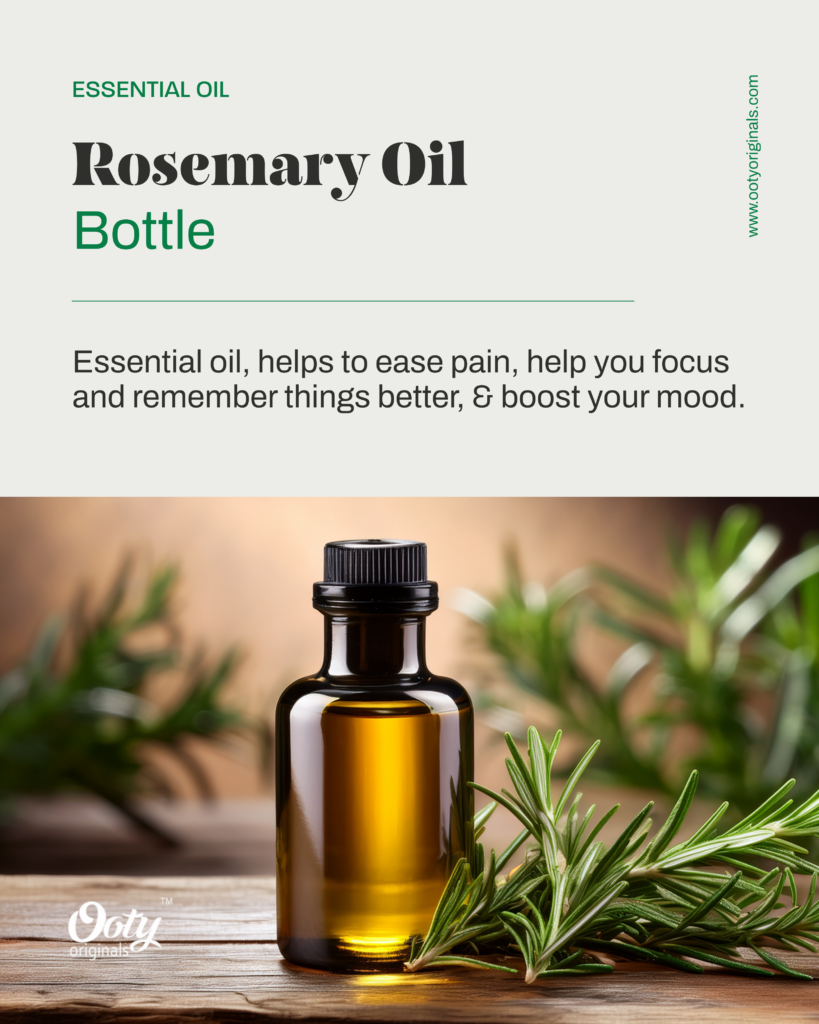
Rosemary Oil: An Evidence-Based Guide to Benefits, Research, Safety & Quality
Introduction
Today, modern science is increasingly investigating this aromatic essential oil for its potential role in hair care, cognitive performance, antimicrobial activity, and overall well-being. Rosemary oil has been valued for centuries in traditional wellness practices, culinary applications, and natural personal care. Extracted from the fragrant leaves of Rosmarinus officinalis (now scientifically classified as Salvia rosmarinus), rosemary oil contains numerous naturally occurring bioactive compounds that contribute to its distinctive aroma and biological properties.
At Ooty Originals, we believe consumers deserve accurate, science-based information rather than exaggerated claims. This guide explores what current research says about rosemary oil, including where evidence is strong, where it remains limited, and how to use it safely and responsibly.
What is Rosemary Oil?
Rosemary oil, also known as Rosmarinus officinalis oil, is an essential oil obtained primarily through steam distillation of fresh flowering tops and leaves of the rosemary plant. Native to the Mediterranean region, rosemary is now cultivated worldwide, including in India’s Nilgiri Hills, where favorable climatic conditions support the growth of highly aromatic plants.
The oil possesses a fresh, herbaceous, woody fragrance with subtle camphoraceous notes. It is widely used in:
Consumers may also encounter alternative spellings such as rozmarin oil or rojmeri oil, referring to the same botanical ingredient.
Botanical Source & Extraction Process
Botanical Name:
Rosmarinus officinalis L. (Current accepted botanical classification: Salvia rosmarinus)
Plant Family:
Lamiaceae
Premium rosemary oil is produced using steam distillation, the preferred method for preserving volatile aromatic compounds.
The process involves:
Steam distillation minimizes thermal degradation while maintaining the integrity of naturally occurring compounds. Factors such as harvest timing, climate, altitude, and post-harvest handling significantly influence oil quality.
Chemical Composition & Active Compounds
Rosemary oil contains over 100 naturally occurring volatile compounds. The exact composition varies depending on geography, growing conditions, and chemotype.
Major constituents commonly include:
How These Compounds Work
1,8-Cineole
Human and laboratory studies suggest this compound may influence neurotransmitter activity and improve alertness by affecting cholinergic pathways involved in memory and attention. More large-scale clinical trials are still needed.
Alpha-Pinene
Laboratory research indicates antioxidant and anti-inflammatory properties. It may also contribute to antimicrobial activity.
Camphor
Known for its cooling sensation and topical stimulation. Excessive exposure should be avoided because high concentrations may cause irritation or toxicity.
The biological activity of rosemary oil results from the interaction of multiple compounds rather than a single ingredient.
Latest Scientific Research & Findings
Modern research on rosemary oil continues to expand across several areas.
Hair Growth
One of the most widely cited human clinical studies compared rosemary oil with topical 2% minoxidil for androgenetic alopecia. After six months, participants in both groups experienced improvements in hair count, while the rosemary group reported less scalp itching.
Scientific mechanism
Researchers believe rosemary oil may:
Evidence level: Human clinical study
Limitations: More large multicenter trials are required before definitive conclusions can be made.
Cognitive Performance
Several small human studies suggest rosemary aroma may temporarily enhance:
Scientific mechanism
The compound 1,8-cineole may inhibit acetylcholinesterase, increasing acetylcholine availability—a neurotransmitter involved in learning and memory.
Evidence level: Human experimental studies
Limitations: Effects are generally short-term and study populations are relatively small.
Antioxidant Activity
Laboratory studies demonstrate that rosemary oil contains compounds capable of neutralizing free radicals.
Scientific mechanism
Terpenes and phenolic compounds help reduce oxidative damage in laboratory models.
Evidence level: Laboratory studies
Limitations: Laboratory antioxidant activity does not necessarily translate directly into clinical benefits in humans.
Antimicrobial Properties
Numerous laboratory studies have shown rosemary oil can inhibit certain bacteria and fungi under controlled conditions.
Scientific mechanism
Essential oil components disrupt microbial cell membranes, increasing permeability and interfering with cellular function.
Evidence level: Laboratory research
Limitations: Laboratory effectiveness should not be interpreted as evidence that rosemary oil can treat infections in humans.
Anti-Inflammatory Potential
Animal and laboratory studies suggest rosemary oil may influence inflammatory signaling pathways.
Scientific mechanism
Certain constituents appear to reduce production of inflammatory mediators while supporting antioxidant defense systems.
Evidence level: Animal and laboratory studies
Limitations: Human clinical evidence remains limited.
Evidence-Based Benefits
Current research supports several potential applications of rosemary oil, although evidence varies in strength.
May Support Hair Health
Human clinical evidence suggests rosemary oil may improve hair density in certain forms of hair loss when used consistently over several months.
May Promote Mental Alertness
Aromatherapy studies indicate temporary improvements in attention and cognitive performance following inhalation.
Supports Aromatherapy
Its refreshing aroma is widely used to promote a sense of focus and mental clarity. While many users report positive experiences, psychological responses vary between individuals.
Natural Antioxidant Source
Laboratory research consistently demonstrates antioxidant activity that may help protect plant-derived formulations from oxidative degradation.
Cosmetic Applications
Rosemary oil is commonly included in shampoos, scalp serums, facial cleansers, soaps, massage oils, and skincare products for its fragrance and functional properties.
Traditional Uses vs Modern Research
| Traditional Uses | Scientific Evidence |
| Hair nourishment | Supported by limited human clinical studies |
| Memory enhancement | Supported by small human aromatherapy studies |
| Massage therapy | Primarily traditional use; limited clinical evidence |
| Skin cleansing | Laboratory antimicrobial evidence supports cosmetic applications |
| Digestive wellness | Mostly traditional use; insufficient clinical evidence |
Many traditional uses continue to inspire modern research, but not all have been confirmed through rigorous clinical trials.
Recent Industry News & Innovations
The global essential oils market continues to expand, driven by growing consumer interest in plant-based wellness products, clean-label cosmetics, and aromatherapy.
Recent innovations include:
Researchers are also investigating rosemary-derived compounds for future pharmaceutical and nutraceutical applications, although many of these remain in early-stage research.
Quality Standards & Purity Factors
High-quality rosemary oil should exhibit:
Adulterated essential oils may contain cheaper synthetic compounds or carrier oils that reduce authenticity and quality.
How to Use Safely
For topical application:
For aromatherapy:
Rosemary essential oil should not be ingested unless under the guidance of a qualified healthcare professional, as essential oils are highly concentrated.
Who Should Avoid It
Consult a healthcare professional before use if you are:
Individuals with sensitive skin may experience irritation even after dilution.
Sustainability & Sourcing
Responsible sourcing helps preserve botanical resources while supporting farming communities.
At Ooty Originals, we prioritize:
By emphasizing responsible sourcing and quality assurance, we aim to deliver rosemary oil that reflects both nature’s integrity and modern quality standards.
Why Choose Ooty Originals
Ooty Originals combines traditional botanical knowledge with modern quality practices.
Our rosemary oil is selected with attention to:
Whether used for aromatherapy, personal care, or hair care formulations, Ooty Originals offers rosemary oil crafted with quality and authenticity in mind.
Conclusion
Rosemary oil remains one of the most extensively researched essential oils available today. Human clinical studies provide encouraging evidence for its role in hair care and cognitive performance, while laboratory research highlights antioxidant, antimicrobial, and anti-inflammatory properties. However, many traditional uses still require larger, well-designed clinical trials before firm conclusions can be drawn.
Consumers should choose high-quality, authentic rosemary oil from trusted brands, use it according to recommended safety guidelines, and maintain realistic expectations based on current scientific evidence. With a commitment to purity, responsible sourcing, and quality assurance, Ooty Originals brings you rosemary oil that supports informed, nature-inspired wellness.
Frequently Asked Questions (FAQs)
1. Is rosemary oil good for hair growth?
Human clinical research suggests rosemary oil may support hair growth in individuals with androgenetic alopecia when used consistently over several months. While results are promising, larger clinical studies are still needed to confirm long-term effectiveness.
2. Can rosemary oil improve memory?
Some small human studies indicate that inhaling rosemary oil may temporarily enhance alertness, attention, and certain aspects of memory. However, these effects are generally short-term, and further research is needed.
3. Is rosemary oil safe for daily use?
Yes, when used appropriately. Rosemary oil should always be diluted with a carrier oil before topical application, and users should perform a patch test to check for skin sensitivity.
4. Can rosemary oil treat bacterial or fungal infections?
Although laboratory studies demonstrate antimicrobial activity against certain microorganisms, there is insufficient clinical evidence to support rosemary oil as a treatment for infections. It should not replace medical care.
5. How can I identify pure rosemary oil?
Look for 100% pure steam-distilled Rosmarinus officinalis oil, botanical labeling, batch traceability, GC-MS testing, amber glass packaging, and a reputable manufacturer such as Ooty Originals that emphasizes quality, authenticity, and responsible sourcing.