Product Categories:
Essential Oils, Blog
Cypress Oil: Complete Guide — Science, Benefits, Uses, Safety & Latest Research

Share:

Product Categories:














Authentic Nilgiri Products
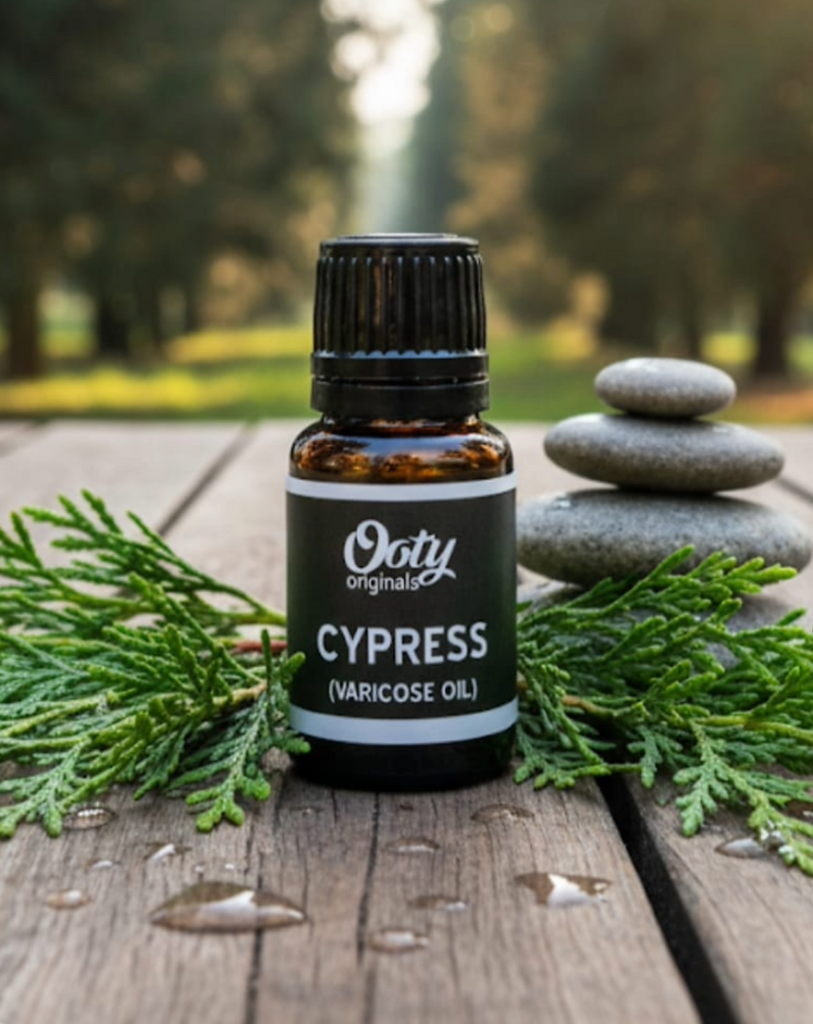
Among traditional botanical extracts that continue to attract modern scientific interest, cypress oil stands out for its distinctive woody aroma and long history of wellness use. Derived primarily from Cupressus sempervirens (Mediterranean cypress), this essential oil has been used across cultures for aromatic rituals, skin care, and circulatory wellness traditions.
Today, interest in cypress essential oil extends beyond traditional aromatherapy. Researchers are actively studying its complex terpene profile, antioxidant activity, antimicrobial potential, and emerging applications in wellness and natural product development.
At the same time, scientific understanding remains nuanced: while laboratory findings appear promising in several areas, human clinical evidence remains limited for many popular claims.
This guide explores what current evidence says—and does not say—about cypress oil.
Cypress oil is an aromatic essential oil obtained mainly from the leaves, twigs, and cones of Cupressus sempervirens, an evergreen tree belonging to the Cupressaceae family.
Native to Mediterranean regions, cypress trees have historically symbolized longevity and resilience. Traditional medicine systems used different parts of the tree for aromatic preparations and topical applications.
Modern essential oil production concentrates volatile plant compounds into a highly aromatic extract.
Cypress oil is widely used in:
Its scent profile is typically:
Cupressus sempervirens L.
Cupressaceae
Most premium cypress essential oil is produced through steam distillation.
This method helps preserve heat-sensitive aromatic compounds while minimizing chemical alteration.
Extraction conditions—including harvest season, climate, and distillation time—significantly influence oil chemistry and aroma.
Recent research demonstrates that regional growing conditions can substantially alter phytochemical composition and biological activity profiles of cypress-derived extracts.
Cypress oil contains dozens of naturally occurring volatile compounds.
Major constituents commonly reported include:
| Compound | Typical Role Studied |
|---|---|
| α-Pinene | Aromatic, antioxidant interest |
| δ-3-Carene | Fragrance and bioactivity studies |
| Limonene | Oxidative defense research |
| Cedrol | Relaxation and aromatic applications |
| Terpinolene | Antioxidant investigation |
| Sabinene | Functional terpene component |
Studies continue to identify variations in composition depending on geography and extraction conditions.
Many terpene molecules appear to influence biological pathways through:
However, these mechanisms are primarily demonstrated in laboratory environments and should not automatically be interpreted as proven clinical effects in humans.
Scientific interest in cypress oil has accelerated in recent years.
A 2024 investigation evaluating Cupressus sempervirens essential oil reported notable antioxidant and antimicrobial activity in controlled laboratory settings and identified several bioactive terpene compounds contributing to observed effects. The findings remain preclinical and do not establish human therapeutic outcomes.
A 2026 study further explored anti-inflammatory and neuroprotective potential using laboratory and computational approaches. Researchers observed interactions suggesting biological activity, but emphasized the need for validation through animal and human studies.
A broader pharmacological review published in recent years concluded that Cupressus sempervirens contains numerous promising phytochemicals but highlighted insufficient clinical evidence for routine medical use.
Researchers are increasingly focused on:
Moderate for aromatherapy experience; limited for clinical outcomes.
Cypress oil’s woody profile is commonly used in relaxation rituals.
The proposed mechanism involves stimulation of olfactory pathways that may influence autonomic nervous system responses.
Current evidence supporting emotional wellness effects is largely extrapolated from broader aromatherapy literature rather than robust cypress-specific human trials.
Supported in laboratory studies.
Multiple studies have reported antioxidant properties in cypress-derived extracts and essential oils. Researchers suggest terpene compounds may help neutralize oxidative processes under experimental conditions.
Laboratory antioxidant activity does not necessarily translate into measurable health outcomes in humans.
Laboratory evidence exists; human evidence limited.
Studies have demonstrated activity against selected microorganisms and biofilm models under controlled conditions. Proposed mechanisms include disruption of microbial membranes.
Essential oils should not replace medical treatment for infections.
Traditional use with limited direct clinical evidence.
One of the most searched applications is cypress oil for varicose veins.
Traditionally, diluted cypress oil has been incorporated into massage routines intended to support comfort and circulation.
Scientific support remains limited.
Possible theoretical mechanisms discussed in wellness literature include:
Current research does not support cypress oil as a treatment for venous disease.
People with persistent swelling, pain, or vascular concerns should seek medical evaluation.
Traditional and cosmetic use supported; medical claims not established.
Cypress oil appears in cosmetic formulations because of:
Patch testing remains advisable.
| Traditional Use | Modern Evidence |
| Circulatory wellness | Limited human evidence |
| Relaxation rituals | Some aromatherapy support |
| Skin applications | Cosmetic use established |
| Air purification | Laboratory antimicrobial evidence |
| Respiratory comfort | Insufficient clinical data |
Historical use provides valuable cultural insight, but modern science evaluates outcomes using controlled methods.
Ethnobotanical reviews show cypress has maintained medicinal and ceremonial relevance across Mediterranean traditions for centuries.
The essential oil industry is shifting toward greater transparency and scientific validation.
Recent developments include:
GC-MS profiling is becoming increasingly standard to verify authenticity.
Manufacturers are optimizing distillation to reduce water and energy use.
Researchers have explored nanoemulsion delivery systems to improve stability and functionality of cypress-derived compounds.
Consumers increasingly expect scientific backing rather than traditional claims alone.
High-quality cypress oil should prioritize:
Look for:
Cupressus sempervirens
Steam-distilled oils are generally preferred.
Confirms terpene composition.
Avoid undisclosed fragrance additives.
Dark glass bottles help reduce oxidation.
Origin and harvest information increase transparency.
Because essential oil composition varies naturally, slight differences in aroma can occur between batches.
General wellness applications include:
Use according to diffuser instructions.
Always dilute before skin use.
Typical wellness practice:
1–2% dilution in carrier oil.
Can be incorporated into professional wellness routines.
Essential oils are highly concentrated botanical extracts.
Use additional caution if:
Consult healthcare professionals when uncertain.
The future of botanical wellness depends on responsible sourcing.
Important sustainability indicators include:
Responsible sourcing supports both product quality and long-term ecological resilience.
At Ooty Originals, botanical wellness is approached with a focus on authenticity, quality, and responsible sourcing.
When selecting essential oils, consumers increasingly value:
A premium cypress oil experience should balance traditional botanical heritage with modern quality expectations.
Cypress oil remains one of the most intriguing botanical extracts in modern wellness.
Research continues to reveal fascinating insights into its chemistry and biological activity—particularly antioxidant, aromatic, and antimicrobial potential. However, many widely circulated health claims still require stronger human evidence.
Used responsibly and chosen carefully, cypress essential oil can be appreciated as part of a broader wellness lifestyle rather than as a medical solution.
As scientific understanding evolves, consumers benefit most from products that combine traditional wisdom, transparent sourcing, and evidence-based communication.
Cypress oil is commonly used for aromatherapy, massage blends, skincare formulations, and aromatic wellness practices.
Some antioxidant and antimicrobial effects have been demonstrated in laboratory studies, but many wellness claims require stronger human evidence.
Traditional use exists, but current evidence does not support cypress oil as a treatment for varicose veins.
When properly diluted, many people use it in cosmetic routines, but patch testing is recommended.
Check botanical name, extraction method, testing transparency, packaging quality, and sourcing information.