Product Categories:
Blog, Essential Oils
Nilgiri Oil: Uses, Benefits, Scientific Research & Quality Guide | Ooty Originals

Share:

Product Categories:














Authentic Nilgiri Products
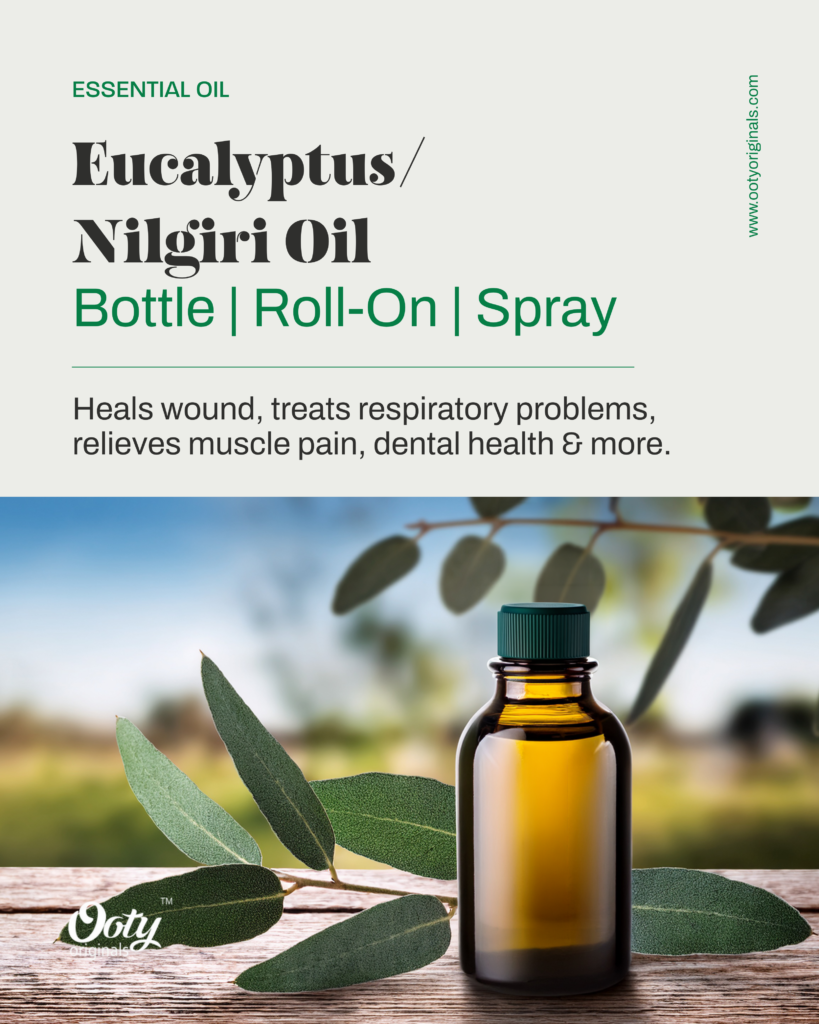
Nilgiri Oil is the traditional Indian name for eucalyptus essential oil, valued for its fresh, invigorating aroma and versatile applications in aromatherapy, personal care, and household wellness. Distilled from eucalyptus leaves grown in regions such as the Nilgiri Hills, this essential oil has been used for generations to support respiratory comfort, massage, and natural cleansing. Modern scientific research has identified 1,8-cineole (eucalyptol) as its primary bioactive compound, with studies suggesting antimicrobial, anti-inflammatory, and mucolytic properties. However, while evidence supports certain uses, many traditional claims continue to require larger human clinical studies. At Ooty Originals, we provide premium Nilgiri Oil that combines botanical purity with rigorous quality standards.
Nilgiri Oil is an essential oil obtained primarily from the leaves of Eucalyptus globulus, although other Eucalyptus species may also be used. Known for its refreshing aroma, it is commonly incorporated into diffusers, massage oils, balms, soaps, and natural cleaning products. Consumers often explore Nilgiri Oil uses for aromatherapy, topical wellness, and household applications.
Fresh eucalyptus leaves are harvested and subjected to steam distillation, the preferred extraction method for preserving volatile aromatic compounds. Growing conditions, harvesting season, and distillation techniques influence the oil’s chemical composition and overall quality.
The major constituent of Nilgiri Oil is 1,8-cineole (eucalyptol), which typically accounts for 60–85% of premium-quality oil. Other naturally occurring compounds include α-pinene, limonene, p-cymene, and globulol.
Scientific mechanism: Research suggests that 1,8-cineole influences inflammatory pathways, supports normal mucus clearance (mucolytic activity), and exhibits antimicrobial properties by affecting microbial cell membranes.
Evidence: Human clinical studies have primarily evaluated purified cineole, while laboratory and animal studies have investigated whole eucalyptus oil. Additional clinical research on the essential oil itself is still evolving.
Recent studies have demonstrated antimicrobial and antioxidant activity of eucalyptus oil against selected bacteria and fungi under laboratory conditions. Clinical research involving purified 1,8-cineole has shown potential benefits in supporting respiratory comfort when used alongside conventional medical care. Emerging research is exploring eucalyptus-derived compounds for oral care, eco-friendly disinfectants, and plant-based wellness products, though many applications require further human trials.
Current evidence suggests Nilgiri Oil benefits may include:
Nilgiri Oil should not replace prescribed medical treatments for respiratory or other health conditions.
Traditionally, Nilgiri Oil has been used in steam inhalation, massage, and topical balms. Modern research supports several biological properties of its primary constituent, 1,8-cineole, but many broader traditional health claims still await confirmation through large, well-designed clinical trials.
The essential oil industry is increasingly adopting GC-MS purity testing, sustainable eucalyptus cultivation, and traceable sourcing. Advances in eco-friendly steam distillation and botanical authentication are helping manufacturers produce higher-quality, more sustainable essential oils.
Choose Nilgiri Oil that is:
Dilute Nilgiri Oil with a carrier oil before topical application and perform a patch test. Use only recommended quantities in diffusers, avoid contact with the eyes, and never ingest the oil unless directed by a qualified healthcare professional.
Consult a healthcare professional before use if you are pregnant, breastfeeding, have asthma, epilepsy, or intend to use Nilgiri Oil on infants or young children. Individuals with sensitive skin should exercise caution and perform a patch test before regular use.
At Ooty Originals, we prioritize responsibly sourced eucalyptus leaves, sustainable harvesting practices, and quality-focused steam distillation. Our commitment to careful sourcing and rigorous quality control helps preserve the oil’s natural purity while supporting environmentally responsible production.
Ooty Originals offers premium Nilgiri Oil crafted with authenticity, purity, and consistency in mind. Every batch undergoes careful quality testing to ensure a fresh aroma, reliable composition, and a product suitable for aromatherapy and personal care applications.
Nilgiri Oil continues to be one of the most widely researched essential oils, thanks to its naturally high 1,8-cineole content. Scientific evidence supports several of its biological properties, particularly its antimicrobial, antioxidant, and respiratory-related effects, while additional human studies are needed to validate many traditional uses. Choosing high-quality Nilgiri Oil from Ooty Originals ensures purity, responsible sourcing, and confidence in your daily wellness routine.
1. What are the common Nilgiri Oil uses?
Nilgiri Oil is widely used in aromatherapy, massage oils, steam inhalation, topical balms, and natural household products.
2. What are the scientifically supported Nilgiri Oil benefits?
Research supports antimicrobial, antioxidant, and anti-inflammatory properties, particularly through its major constituent, 1,8-cineole. Human evidence is strongest for purified cineole in respiratory support.
3. Is Nilgiri Oil the same as eucalyptus oil?
Yes. In India, Nilgiri Oil is the traditional name commonly used for eucalyptus essential oil, especially when obtained from Eucalyptus globulus.
4. Can Nilgiri Oil be applied directly to the skin?
No. It should always be diluted with a suitable carrier oil before topical application to reduce the risk of skin irritation.
5. How can I identify pure Nilgiri Oil?
Look for 100% pure, steam-distilled oil that is GC-MS tested, clearly labeled with its botanical name, and sourced from trusted brands like Ooty Originals.